For Dalit History Month, three KL Hatke stories are unlocked for a limited time, read them now.
The Iconography of Dalit Resistance: Contestations over Ambedkar Statues in U.P.
Cast(e) Away: Histories of Displacement and Survival
Why does living off scraps become a necessity? Who decides whose labour is worth discarding, whose hunger is an afterthought? And more crucially—why do these so-called ‘Fokatpuras’ always end up being Dalit settlements?
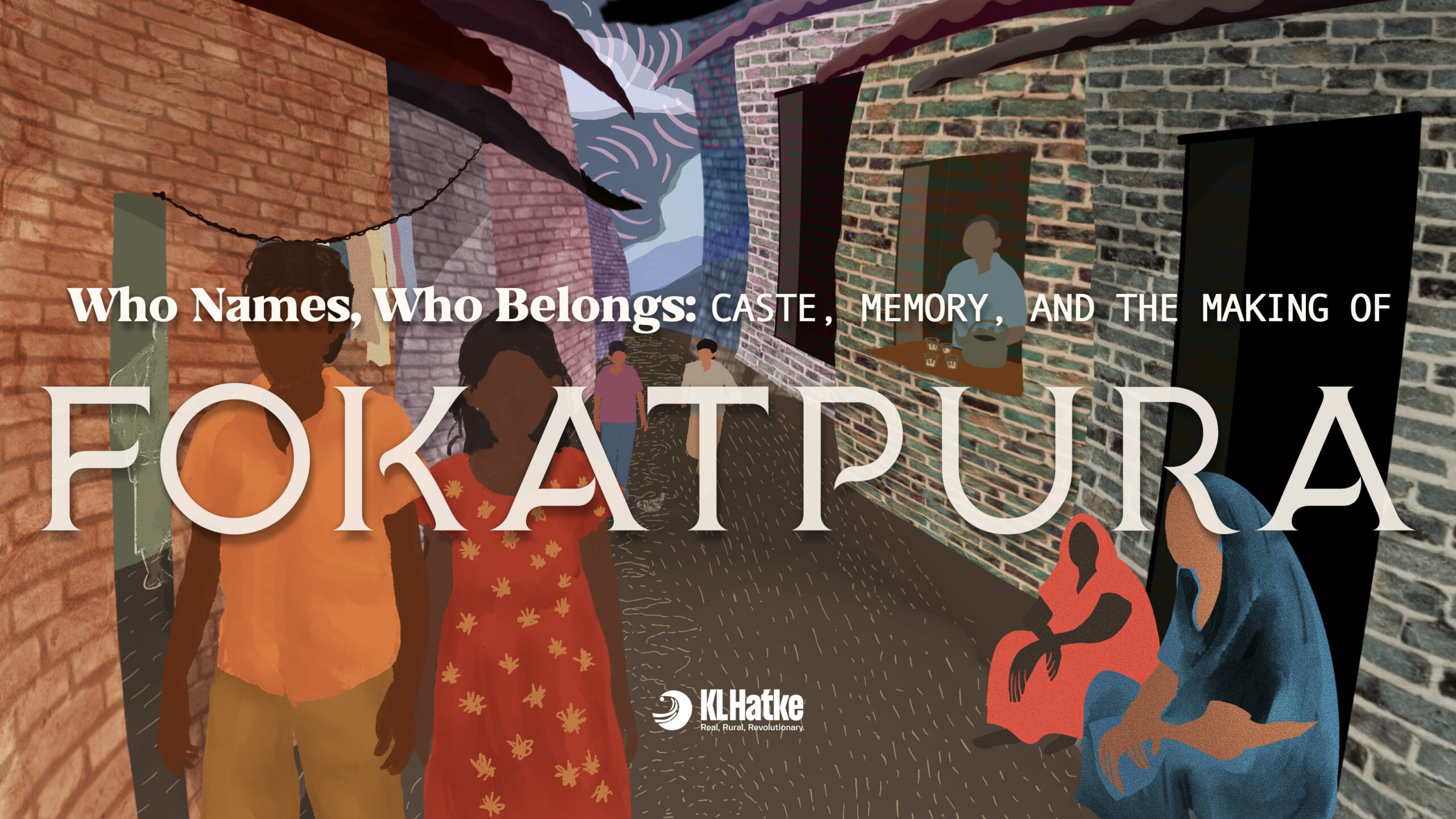
Origins & Meaning
- Fokat (फोकट) means free, worthless, or without value.
- Pura (पुरा) typically refers to a settlement, village, or locality.
- Together, Fokatpura implies a place associated with ‘freeloaders’ or ‘unproductive’ people—a label often used in a derogatory way.
April marks Dalit History Month: a time to reflect on the resilience, struggles, and ongoing challenges faced by Dalit communities in India. It is a month dedicated to understanding their history, the legacies of systemic oppression, and the ongoing fight for dignity and justice.
This year, we took a step back to revisit the countless reports from Dalit bastis in Banda, Chitrakoot, Tikamgarh, Chhatarpur, Prayagraj, Mahoba, Varanasi, and Panna. We asked: how did these settlements come to be? Why are they named the way they are? How are they perceived by those around them? How do geographic and social isolation intersect? And how have decades of neglect shaped life in these bastis? These questions call for a deeper look into spaces where this history continues to unfold—the places often left off maps and erased from official records, where Dalit lives are marked by struggle, survival, and invisible labour.
One such place is Fokatpura, the Dalit settlements in Madhya Pradesh, where history, caste, and survival collide. Here, the strands of marginalisation stretch across generations, with residents surviving at the periphery of the town, both physically and socially. The story of Fokatpura exemplifies the erasure of Dalit communities in the larger narrative—where land and history are denied, and caste-based discrimination continues to dictate life and opportunity. This feature traces the history of Fokatpura and examines its present, revealing the systemic neglect and daily endurance of those who call this settlement home.
Saroj, who works as a domestic worker in Sirali, sometimes wonders about the name of her neighborhood. “I often wonder why the place we live in has ‘fokat’ in its name,” she says. But it’s always been a passing thought. She once asked the elders about it, but no one seemed to know. The name has always been there, just like the people who live in Fokatpura. No one remembers how it started, only that it stayed.
Sirali, a small town in central India’s Harda district moves to the rhythm of its own pace—unhurried, deliberate, and unbothered by the world beyond its slow, sun-drenched lanes. This town wakes up early, but time stretches differently here. Shops roll up their shutters with the first light, knowing full well that some days might pass without a single customer. Still, they stay open. Because in Sirali, opening the shop is the business, whether or not a sale happens.
Behind the town’s busiest pocket—Gandhi Chowk, where the real action is, where haggling over vegetables can sound like a fight and the clang of chai glasses punctuates the afternoon—sits its own Fokatpura: a place that exists on the town’s periphery but is stitched into its fabric, its labour invisible yet indispensable.
What’s in a name?
The name ‘Fokatpura’ carries a layered and loaded meaning. In Hindi, Fokat (फोकट) means free, worthless—often used to describe people or things seen as unproductive or of no value. The suffix pura (पुरा) typically refers to a locality or settlement. Together, ‘Fokatpura’ implies a place associated with people perceived as idle or dependent, and the term is often used in a derogatory sense. Sitting under a tin shade in front of her home, 60-year-old Kiran Devi had laughed as she explained it: “Kya hai na, hum to Fokat ke ho gaye sarkar ke liye” (We’ve become worthless in the eyes of the government.) Her tone was sharp but playful, laced with irony, a kind of practiced humour that softened the bitterness of being ignored. The name, as she and others know it, is both a joke and a judgment — one they’ve had to live with for decades.
“Sabne milke decide karliya ki hum fokat ke log hain toh naam de diya Fokatpura” (Everyone just decided that we’re people who amount to nothing, so they named this place Fokatpura), said Kusum. She was sitting on the edge of a low charpai outside her one-room tin-roof house, squinting into the afternoon sun. Around her, kids chased each other with a plastic bottle turned football, and someone in the distance beat clothes dry on a stone. Kusum is a 19-year-old who works as a computer operator in a printing shop.
When the ‘everyone’ refers to the upper-caste, the privileged lot from the main town who are comfortably distanced from the struggles of Fokatpura. “It’s as if they’ve made it their job to define the people of Fokatpura,” says Ramprasad Ivne, member of Jai Adivasi Yuva Shakti (JAYS), Madhya Pradesh. Ivne has been working for tribal and Dalit rights for five years now.
“The name itself, ‘Fokatpura,’ wasn’t something the people here chose willingly. It’s more like a label they were stuck with, pushed on them by those who have everything and more,” he explains. The town’s elite didn’t consider the fact that the people of Fokatpura are fighting every day just to get basic things like water and electricity. Instead, they made it sound like a joke — a name that reflects their disconnect from the reality here, and their view of the people as ‘worthless’ or ‘freeloaders.’ So, when the residents say the name was given to them by the upper-castes, it’s not just about a settlement’s name, it’s about a stamp they’ve been given by people who have never felt the pinch of scarcity or struggle.
Mapping the Margins
Sirali’s Fokatpura, much like the town itself, carries the weight of history. The land once belonged to the Gond kingdom, back when power looked different in these parts. Now, it’s a predominantly tribal settlement, a reminder of who gets pushed where when the town expands. The name in other places comes wrapped in a story, a suggestion of hand-to-mouth survival, of people making do with what they can, when they can. But behind the label is something more: a map of caste and labour, of who gets to be at the center of things and who is always just a street away.
Fakeera, 55, has spent his entire life in Fokatpura, brewing tea and stories in equal measure. His stall is small, just a rickety wooden counter with a few dented steel kettles, but it sees more conversations than most places in Sirali.
“My parents lived here, even their parents settled here,” he says, stirring a pot of bubbling chai as the morning sun spills over the rooftops. “But we don’t know why it is named so.”
It holds more than just forgetfulness—it’s displacement without documentation, of generational settlement without ownership. The people of Fokatpura have always been here, yet no one ever told them why here? The past exists in fragments, stories that trickle down but never quite piece together into an official history.
“And maybe that’s the point. That’s how places like Fokatpura come to be—not through planning, but through unquestioned inheritance. Through people staying where they were once allowed, because the question of where else was never theirs to ask.” adds Fakeera.
Fokatpura isn’t a sprawling settlement, but it’s densely packed. Houses stand closely stacked against each other, separated only by narrow lanes barely wide enough for two people to walk side by side. Most homes are built with bricks and tin roofs, some patched with blue tarpaulin sheets—a sign of repairs that never got completed. There’s little room for open spaces, just a few small courtyards where children play and women gather to chat.
In contrast, Gandhi Chowk, the town’s busiest market area, feels like a different world. Here, shops bustle with customers, carts overflow with vegetables, and the air is thick with the scent of frying snacks. The clatter of utensils, the constant calls of vendors, and the rhythmic haggling over prices fill the space with noisy energy. But just a few minutes’ walk away, in Fokatpura, that energy fades into something quieter, heavier—not of trade and movement, but of waiting, of endurance.
Lefebvre argued that space is not neutral; it is produced by social relations and reflects power structures. “Space is a product of social relations and, like language, it serves as a means of control, of domination, and of power.” The naming and placement of Fokatpura are not accidental, they reflect caste and labour divisions, determining who gets to occupy which spaces and under what conditions.
The settlement lacks a proper drainage system, and during the monsoons, the lanes turn into muddy, stagnant pools. Wastewater seeps into open spaces, forcing people to navigate through damp, slippery paths. Electricity is erratic, and streetlights are few, leaving parts of the area in near darkness at night.
Caste, Identity, and the Politics of Recognition
Fokatpura stretches for about two kilometres, leading up to another Dalit basti—Meghnad Chowk—where Dalit and Muslim families live together. While Meghnad Chowk has slightly better infrastructure, with a few pucca houses and a functional water supply, it shares the same history of marginalisation. The two settlements—though separated by name—are bound by a common struggle, a common exclusion.
Back then, before Fokatpura was a place, it was a way of life — a daily ritual of scavenging. As the mandi’s gunny sacks bulged with fresh arrivals—cauliflowers still carrying the memory of the soil, glistening brinjals, chilies that stung the eyes—some slipped through careless fingers. The market didn’t bother with them, but the people who would later give Fokatpura its name did. They swept through the leftovers, gathering what the city had deemed unworthy, selling what they could, eating what they couldn’t.
The name stuck, long after the practice faded. Now, Fokatpura is no longer about free vegetables—it’s about a label that refuses to leave. The people here have moved on, found other ways to survive, to build, to belong. But in the city’s collective memory, they are still the ones who lived off fokat. The ones who made a life from what others discarded.
For older residents like Fakeera, Fokatpura is just a fact of life—a name they grew up with, a place they made home. But for younger generations, the name carries a different burden.
Mahima, Fakeera’s 14-year-old daughter and a ninth-grade student, hesitates when asked where she lives. “I feel shy about telling people where I am from in school,” she admits. The word ‘fokat’ (meaning worthless) often draws snickers or dismissive glances, marking students from the settlement before they even introduce themselves.
Mahima’s friend Rupali says “When I hear my classmates talk about Fokatpura, I feel like they see us as less than them. But I know I can do anything they can do. I’ll show them, one day.”
Discrimination is almost default when students are asked about their address. Even when no words are spoken, the reactions are telling—a quiet moment of recognition, a shift in tone, a lingering assumption.
Unlike other Dalit settlements that have pushed for renaming—places reclaiming dignity with names like Ambedkar Nagar or Shivaji Nagar—no such effort has taken root in Fokatpura. The name remains, its meaning shifting in the minds of those who carry it.
Even if the oral history of Fokatpura faces caste prejudice, there’s no official record to confirm whether its origin story—of people living off fallen vegetables—is fact or fiction. But while mapping the area’s demography, the numbers told their own truth. Out of the 150 families surveyed, 110 belonged to Dalit castes, 20 were from OBC communities, and the rest were Muslims and Adivasis.
Despite generations of residence, their economic roles remain largely caste-determined. Over 70% of Dalit families are engaged in caste-based occupations like sanitation work, while the majority of OBC residents work as daily-wage labourers or fruit vendors. This caste-based segregation of labour keeps upward mobility out of reach.
Housing, too, is precarious. While all 150 families hold pattas (land lease documents), they offer little security. Fakeera’s home has been demolished three times, alongside 50 other Dalit homes—all under anti-encroachment drives that spared upper-caste residences and commercial spaces nearby. These selective demolitions highlight how the state weaponises land laws against Dalits while protecting privileged communities.
Even basic identity documents are subject to caste politics. Saroj, from the Kori caste, has been unable to obtain a caste certificate because the tehsildar insists that Kori families should reclassify as Gond, a Scheduled Tribe. Without this certificate, she and others like her are denied reservations, scholarships, and other entitlements, showing how caste discrimination is embedded in bureaucratic systems.
Caste and Education: Who Gets to Study?
The impact of caste is stark in education. Out of the 150 families interviewed, only 43 had children who pursued higher education—a mere 33% completion rate. Dropout rates rise along caste lines, with Dalit children leaving school at significantly higher rates than their OBC and Muslim counterparts.
A major reason for this is economic instability, but documentation barriers also play a role. Without caste certificates, dozens of Dalit children in Fokatpura have been unable to claim government scholarships that could have supported their studies. The pattern is clear: from livelihood to housing to education, caste dictates who gets opportunities and who remains trapped in a cycle of deprivation.
Why does living off scraps become a necessity? Who decides whose labour is worth discarding, whose hunger is an afterthought? And more crucially—why do these so-called ‘Fokatpuras’ always end up being Dalit settlements?
Living in Limbo: Story of Another Fokatpura
“And this isn’t the only Fokatpura. In every village and district of Madhya Pradesh, you’ll find your own Fokatpura.” says Ivne. About 25 kilometres from Sirali, Sukhras village has its own Fokatpura.
A survey of the area showed that all 45 families living there are Dalits, along with 10 families from the Gond tribe, classified as Scheduled Tribes. Like in Sirali, the name lingers, shaping how people see the place and those who live in it.
The pattern repeats itself—Fokatpura isn’t just a name, it’s a marker of caste and history dictating who belongs where.
The families in Fokatpura, Sukhras, have lived there for at least two decades, though they are not first-generation settlers. Most of the residents work as land labourers, a reflection of caste and tribal roles deeply embedded in the area. The name ‘Fokatpura’ is neither embraced nor rejected—it’s simply accepted as part of their daily existence. There’s been little effort to change their status; no petitions for land rights or basic services have been made, leaving them in a cycle of neglect. For the younger generation, like Seema, a 20-year-old resident, the future feels uncertain. She says, “A roof above my head comforts me more than the discomforts of its name.”
Caste in cities often hides in the fine print, in euphemisms, in municipal records that classify neighborhoods by ‘economic status’ rather than centuries of exclusion. But here, in the clustering of Dalit families along a nullah, in the way land and opportunity funnel downward, the pattern is impossible to ignore. Scraps, whether of food, work, or dignity—always seem to land in the same hands.
Fokatpura stands on government land, granted under a system commonly known as ‘patta’. But a patta is not ownership. It is conditional permission to occupy land, making homes here perpetually vulnerable.
Fakeera has seen his house demolished three times since he started living in Fokatpura. “They call it ‘atikraman’ (encroachment),” he says, shaking his head. Each time, it wasn’t just his home—around 50 other houses were also razed, their residents forced to rebuild from the rubble.
Yet, despite these demolitions, there have been no major town planning efforts in Sirali. Fokatpura has survived, not because of legal recognition, but because the state’s neglect has left it in an uneasy limbo. There are no permanent land titles or property records, leaving its people stuck in a cycle of informality, eviction, and rebuilding.
Unlike in bigger cities, where Dalit settlements are steadily pushed outward for commercial expansion, Fokatpura persists—not because it is protected, but because it is ignored.
Erased on Paper, Ignored in Policy
Fokatpura exists, but only in the lives of its residents—not in official records beyond their Aadhar cards. There are no signboards marking its name, no mention of it in municipal documents, and no recognition on town planning maps. While residents’ Aadhar cards (a 12-digit unique identification number issued by the Unique Identification Authority of India (UIDAI) to Indian residents) list their address as Fokatpura, government schemes and official planning treat the settlement as non-existent. This erasure is not accidental—it is a form of systemic neglect that allows authorities to bypass responsibility for its Dalit residents.
The land in Fokatpura is government-owned, allotted under pattas (land lease documents). But these pattas do not provide real security. Fakeera’s house, along with 50 others, has been demolished thrice under anti-encroachment drives, even though the families have been living here for decades. The demolitions are selective while Dalit homes are razed, nearby commercial spaces and upper-caste houses remain untouched.
Fokatpura’s status as ‘encroachment’ also means that residents are denied benefits under Pradhan Mantri Awas Yojana (PMAY), which provides housing assistance. Despite meeting the income criteria, their applications are often rejected because their settlement is deemed ‘unauthorised’—a bureaucratic term that allows the state to ignore them.
Unlike the main market area of Gandhi Chowk, which has paved roads and proper drainage, Fokatpura has no sewage system. Wastewater from homes flows into open drains or stagnates in empty plots, making it a breeding ground for diseases. In monsoons, the entire area becomes waterlogged, forcing residents to wade through knee-deep sewage.
For drinking water, most households rely on hand pumps or private water tankers. There is no government-installed piped water supply. Women and children often walk long distances to collect water, a stark contrast to the market area just a few streets away, where shops and businesses receive regular municipal water supply.
There is no government health center inside Fokatpura. The nearest Primary Health Center (PHC) is in the town center, several kilometres away. Without proper transport, many residents—especially elderly and disabled people—struggle to access medical care. Pregnant women often rely on ASHA workers for home-based deliveries because reaching a hospital in time is difficult.
This lack of access has consequences. Infant mortality, malnutrition, and seasonal disease outbreaks are common in Fokatpura, yet there is no local health infrastructure to address them.
Erasure Through Denial: How Authorities Frame Fokatpura
When asked about Fokatpura, Neeta Agrawal, the Chairperson of City Council in Sirali, denies any caste-based history associated with the settlement, saying, “There’s no caste-based history associated with Fokatpura.” This statement reflects a larger pattern in governance where caste segregation is either ignored or reframed as a mere issue of poverty or urban planning, rather than a result of deep-seated social exclusion. This denial is significant because it erases the historical and structural reasons behind the existence of Fokatpura:
Why does Fokatpura exist outside the main town? Why does it lack basic services like drainage, water supply, and proper sanitation? Why are its residents more vulnerable to displacement and evictions? The answer to these questions lies in caste, but authorities choose to overlook this connection.
In choosing not to acknowledge caste as a defining factor, the authorities miss an opportunity to address the root causes of inequality in the settlement. Instead of confronting caste-based disparities, they are quick to adopt a narrative that focuses on poverty or underdevelopment. By refusing to name caste as the issue, they fail to address the broader systemic structures that sustain this exclusion.
Erasure Through ‘Development’
While the authorities downplay caste as a factor in the existence of Fokatpura, they do recognise it as a space that needs improvement. The chairperson frames it as an underdeveloped zone in need of intervention, using terms like ‘upgradation’ and ‘improvement’. This framing is significant because it reflects a wider tendency among the upper-caste power structures to view Dalit settlements not through the lens of rights, but as areas in need of modernisation.
This framing of Dalit areas as problematic zones that need development is problematic because it often becomes a justification for displacement. When local authorities, or dominant caste groups, label these areas as underdeveloped or in need of improvement, they often mean that these settlements should be removed or relocated to make space for new commercial developments, upper-caste housing, or urban expansion. This rhetoric can lead to eviction or forced relocation under the guise of providing better infrastructure, when in reality, it often results in further marginalisation of already vulnerable communities.
How Does the Town View Fokatpura?
“We do not associate with those people,” says Ganga Patel, a resident of Gandhi Chowk, when asked if he would consider moving to Fokatpura. “But why is that so?” I asked. He scoffed and replied, “Hum koi fokat hain kya jo Fokatpura mein rahenge?” (Are we freeloaders that we would live in Fokatpura?) Implying that everyone in Fokatpura is a freeloader, this prejudice isn’t confined to the older generations. Even children here use ‘Fokatpuriya’ as an insult, hurling it at their peers during fights.
The absence of Fokatpura from official maps, the selective denial of government schemes, and the rhetoric of ‘improvement’ all point to a clear, unspoken agenda: Fokatpura is not meant to be permanent. In fact, Fokatpura is not even listed on Sirali’s official map. This reinforces the idea that the settlement is invisible, both in the eyes of the government and the town’s official records.
When a settlement like Fokatpura doesn’t appear on government records or maps, it’s as if it doesn’t officially exist. This administrative invisibility means the people living there can’t demand basic rights like access to healthcare, education, electricity, ration cards, or compensation in times of crisis because, on paper, they aren’t recognised as citizens of a place.
“Their absence from maps isn’t just an oversight, it’s rather part of a broader pattern of how the state sidelines the most vulnerable communities.” says Sanjay Dubey, a local journalist and social worker.
This erasure is not unique to Fokatpura or Sirali. Across India, Dalit settlements are often given generic names or rebranded with terms that strip them of their caste identity. They are classified as ‘unauthorised’ or ‘temporary’, a convenient justification for denying these settlements access to basic services or government schemes.
Moreover, when these settlements are visible in official records, they are typically treated as informal or encroachments, with no formal recognition of the residents’ rights. Their lands are seen as ‘disputed’ or ‘government land’, making them vulnerable to eviction or demolition at any time. Fokatpura’s residents continue to live in a state of uncertainty, with no real legal claim to their homes or land.
Similar Settlements Across Madhya Pradesh and India: The Persistent Caste Divide
Similar settlements exist under different names across Madhya Pradesh and beyond. In states like Uttar Pradesh and Bihar, Dalit neighbourhoods are often referred to as ‘Harijan Tola’ or ‘Dom Tola’, naming conventions that reflect both a caste identity and the marginalisation of these communities. These names have become synonymous with areas that are segregated, underdeveloped, and excluded from mainstream urban development. Despite efforts to rename such areas in honour of leaders like Dr B.R. Ambedkar (e.g. Ambedkar Nagar), the caste-based segregation persists, highlighting how these communities continue to be pushed to the periphery of town and city planning. Although there have been some efforts to rename such settlements, residents often take it upon themselves to assert their identity. In Indore, for instance, the children of Fokatpura led an initiative in 2012 to rename their settlement after Tantya Bhil, the revered Adivasi freedom fighter, calling it Tantya Bhil Nagar.
Fokatpura and Its Comparative Geography
When comparing Fokatpura with Dalit and Adivasi clusters in larger cities like Bhopal, Indore, or Jabalpur, one notable difference is the size of the settlements. While caste-based segregation exists in all these areas, smaller towns like Sirali can sometimes present more pronounced patterns of exclusion due to the more centralised control by upper-caste groups. These areas are often overlooked in terms of development and urban planning, with residents in smaller towns having limited recourse to voice their grievances compared to those in larger cities.
In larger cities, Dalit and Adivasi communities may face systemic exclusion, but their settlements are often more visible due to sheer size or urbanisation processes. However, in smaller towns like Sirali, the social dynamics are more tightly controlled, and caste-based discrimination can be more overt, as there is less space for marginalised communities to challenge entrenched systems of power. Here, the name Fokatpura continues to stand as a symbol of exclusion, even as these communities fight for a basic claim to land, services, and dignity.
Caste Structures in Rural and Semi-Urban Areas
The pattern of caste-based segregation in settlements like Fokatpura speaks volumes about how caste structures dominate rural and semi-urban geographies. In Sukhras village, a newer settlement, the area is still referred to as Fokatpura, a clear sign that caste remains the defining factor in the organisation of space, even in newer developments. Despite the settlement’s relatively recent establishment, the name ‘Fokatpura’ persists because of the communities that inhabit it. This name has come to symbolise the marginalised identities of the people living there, with the upper-caste communities in the village continuing to see these groups as ‘outsiders’ despite the physical proximity and co-existence.
What these patterns reveal is that caste-based segregation transcends geography. Whether in a rural village, a semi-urban area, or a major city, the upper-caste groups will always find ways to segregate marginalised communities, making it difficult for them to access the same opportunities, resources, or recognition. No matter where these settlements are located—whether in Sukhras, Sirali, or elsewhere—these communities are always confined to specific areas, systematically excluded from integration into the broader social fabric of their towns and cities.
Credits:
Report and written by Sejal
Edit by Srishti
Design by Jyotsana