 In Pachokhar village of Atarra, Banda the crickets are loud even in daytime. After midnight fell on 15th June last year, when the last person tired by this strange new pandemic had retreated to their bed, someone stole into the village park. The swell of crickets scored the scene — the only witness to an attack that was repeating itself even as the village slept on.
Mahapurush Park is a respite of green and breeze in water-hungry dusty Bundelkhand. A sea of trees and blue sky surround a figure, raised high on a pedestal in the center of the park. In the morning of 16th June, when villagers went to offer their routine-prayers they found that what used to be a statue of Dr. B.R. Ambedkar was missing a head. And the iconic raised arm, with its finger pointing towards a future — that had been broken. The statue stood there, headless still clutching a blue register on which was written, ‘Bharatiya Samvidhan’ (Indian Constitution).
“Naam nishaan khatam kar diya (They destroyed our symbol),” Kalli, a resident of Pachokhar told KL senior reporter Geeta on 17th June, her grey eyes brimming with tears. “If we had any other sahara (support), any God even that looked over us… Ambedkar is the only one.”
The local Buddha vihar manager, the police and SDM, various regional Bahujan Samaj Party (BSP) party workers had all congregated in Pachokhar. “This is the third time that Babasaheb’s statue has been attacked but there has been no arrest. It’s not just about a statue, Babasaheb is an icon for the BSP, and we work towards his ideals,” said Ramsevak, BSP General Secretary in Banda’s Jamreha village. “Tera mein ek baar haath toota tha. Aaj gardan, haath sab toot gaye (In 2013 they had broken the arm. Today the neck, hand, everything has been broken),” said Gulab Singh Varma, BSP Banda’s district head. Back then too a court-case, and FIR had been registered but nothing came of the investigation. The police told KL they had tried, they shrugged indicating what can one do?, perhaps.
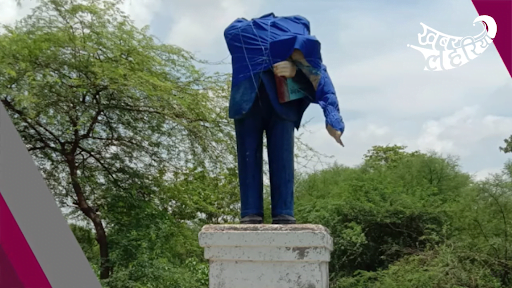
The statue of Ambedkar in Pachokhar village, Banda’s Mahapurush park was vandalised in the dead of night in June 2020.
The statue was speedily replaced by the next day. A recently built statue from nearby Narayanpur village that had not yet been installed was brought into Pachokhar– glasses intact, hair neatly combed and jacketed Constitution-carrying arm, finger raised to the sky. The villagers distributed sweets, the police watched over the installation, flimsy surgical masks safely tucked under several chins.
“These cowards feel a jealousy burning inside them when they see Babasaheb’s statue. They want to prove that Babasaheb se des nahi chalega, Manusmriti ke hisaab se chalega (the country will not run on the ideals of Babasaheb, it will run according to the Manusmriti),” said Dhirendra Kumar of nearby Radheshyam Purva. Soft-spoken but his words piercing, he continued. “Babasaheb is learned and famous, the rashtra nirmata (creator of the nation). In Columbia Journalism School his statue is installed, there he gets respect. Ek Bharat hi aisa des hai jahan samman nahi milta. Samajh lijiye ki yahan murkh zyada log rahte hain- vidwano ki koi value nahi hai. (It’s only India where he doesn’t get respect. You understand, it is more fools who live here — there is no value for learned men.”
When KL left, the painter was perched on a ladder, painting the face of the statue white over the dull grey stone, bringing it alive bit by bit. “Khush khush khush,” Kalli said. (Happy, happy happy).
In Waiting For a Visa, Ambedkar begins, “It is difficult for them [foreigners] to understand how it is possible for a few untouchables to live on the edge of a village consisting of a large number of Hindus; go through the village daily to free it from the most disagreeable of its filth and to carry the errands of all and sundry; collect food at the doors of the Hindus; buy spices and oil at the shops of the Hindu Bania from a distance; regard the village in every way as their home–and yet never touch or be touched by any one belonging to the village.”
At KL as we often say, this is the stuff of daily life and reportage. We know. We know and we write about such Dalit settlements denied clean water, circuitous routes taken by Dalit women through dacoit-filled jungles just to quench thirst. We report on the cattle-skinners and leather workers of Itwa and the children who walk away towards better futures, abandoning a traditional trade in the process. About a primary school in Lalitpur’s Madavara village where the mid-day meal was not eaten because the cook is a Dalit woman. In yet another village of Lalitpur, where people of the Ahirvar caste were denied the “privilege” (read with biting sarcasm) of wearing chappals until KL reportage created a stink about the practice. About the rising figures of caste-violence and the 25 Dalit houses torched in Saharanpur by Thakurs in 2017. The twos systems of “justice” after sexual assault that exist in parallel — one kowtowing to the beck and call of the Thakurs and Brahmins, and the other full of barriers.
In a casteist environment, where the innocuous act of wearing a chappal holds grave stakes, it is obvious that Ambedkar iconography and statues are an important means of Dalit and Bahujan assertion, defiance and resistance. This importance has been reinforced by dominant-caste attempts to injure pride by vandalising statues over the years. In 2019 as debates over ‘merit’ and reservation heated up once again, as the BJP government introduced 10% reservation for economically backward dominant caste groups, a spate of beheadings of Ambedkar statues followed in Azamgarh, U.P. Like the vandalism in Pachokhar village last year, these three beheadings in the villages of Chewar Domanpur, Srikantpur and Mirza Adampur took place under cover of night. This was not the first time Ambedkar statues were desecrated in Azamgarh. In 2018 after unprecedented BJP wins in the north-east, tearing down of Lenin, Periyar and Ambedkar statues followed in Tripura, Tamil Nadu, and in Meerut and Azamgarh in U.P.
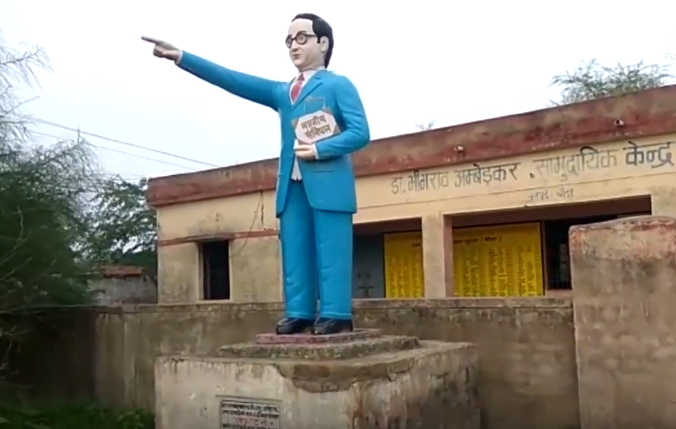
A statue of Ambedkar in Azamgarh in the iconic mould in Banda, 2018.
In Banda, nearly every village and kasbah boasts of a “mandatory Ambedkar statue” as Chief of Bureau Meera Devi puts it. But where did this iconic mould come from?
To go back in time, the practice of erecting statues of political leaders in public spaces was introduced into India by the British and post-independence the newly formed Indian government picked up the practice, installing statues of freedom-struggle leaders like Gandhi, and historical figures. The first official statue of Ambedkar was installed in Bombay in 1962 at the Institute of Science crossing where he was depicted as an orator, “dressed in a three-piece suit, his right arm and finger upraised as a ‘great man lecturing the nation’, including his fellow Dalits to organise for their rights, Tartakov writes. In 1964 a similar statue made of bronze was set up in front of the National Parliament in Delhi — an attempt by the Indira Gandhi-led Congress Party to bring Ambedkar and Dalits within the national ‘secular’ fold. Then, as during Ambedkar’s time, India’s political leaders have been better at embracing the figure of Ambedkar while glossing over his radical anti-caste politics that were at odds with dominant caste hegemony and Hindu power over everything.
In U.P, anthropologist Nicolas Jaoul writes, statues installed by the government have reproduced this bronze iconography while in villages smaller stone models proliferate with their own tweaks like ‘Nike’ painted on shoes or real black plastic glasses — similar to the Ambedkar statues whose contestations KL has covered many a time. Jaoul describes how in Uttar Pradesh specifically, Ambedkar statues have played an instrumental role in the BSP’s successful mobilisations since the mid-1990s, as a political party founded on Ambedkarite politics by Kanshi Ram, and led by Ambedkarite Dalits. Once in power, Jaoul writes, the BSP emphasised official installations of statues and statue-parks particularly during CM Mayawati’s tenure — an act that often drew criticism from dominant-caste led media –ostensibly questioning use of funds, but carrying an unmistakable whiff of superiority. It also encouraged Dalits to install more statues in their villages, Jaoul writes.
KL’s reportage from the field bears out the fact of Ambedkar statues as a deeply emotional issue — as perhaps one tangible element of Dalit and Bahujan assertion and pride in the face of a region where caste is extremely explicit. In 2018, KL reported on large-scale protests by Savarnas (dominant castes) who took to the streets in Mahoba, Chitrakoot and Varanasi demanding the repeal of an amendment of the SC/ST Prevention of Atrocities Act, which allowed arrest of the accused on complaint and prohibited anticipatory bail. The protestors called the amendment a ‘grave atrocity’ — perhaps stemming from their need to perpetuate atrocities against Dalits and Adivasis with nary a chance of their impunity being dented. U.P. is also the region where CM Adityanath was awarded the honour of being a ‘Dalit Mitra’ in 2018 by the Lalji Prasad, President of the Ambedkar Mahasabha against uproar by other members. It will come as no surprise then that Lalji Prasad was appointed the Chairman of the SC Finance Development Commission just a few days later. What can we say? The ‘Dalit mitra’ sent a polite return gift.
Painting it Saffron?
In recent years, BJP and RSS efforts to subsume Ambedkar within a Hindu politic have ramped up. For instance this year Ambedkar Jayanti, the birth date of Ambedkar was celebrated officially as ‘Samrasta Diwas’ On Ambedkar Jayanti in 2018 the BJP carried out an ‘Ambedkar Yatra’ and later that year changed his name in official records and correspondence to Bhimrao ‘Ramji’ Ambedkar against again, opposition from Dalit leaders and locals at this posthumous and frankly, remarkably unsubtle Brahminisation. In fact, just weeks after this move, Badun’s Dugraiyya village brought in an Ambedkar statue literally dressed in a saffron kurta after vandals broke the original.
In response to criticism, CM Adityanath said on record that “saffron represents purity” and invoked the sun as also being undeniably saffron as evidence of those questioning these moves as “narrow minded”. Here we can quote Ambedkar himself who fought all his life against the heinous logic of “purity” and “pollution”, and who declared at the Yeola Conversion Conference in Nasik in 1935: “Though I was born a Hindu, I solemnly assure you that I will not die as a Hindu”. (Government of Maharashtra, 2002, Vol. 18, Part 1, p. 430)
In ‘What Congress and Gandhi did to the Untouchables’, Ambedkar wrote about the indifference of the dominant caste led Congress pre-independence to the inequities of Dalits, and a lapsed resolution which it ultimately lay on the door of the Hindu Mahasabha:
“There could not be a body most unsuited to take up the work of the uplift of the Untouchables than the Hindu Mahasabha. If there is any body which is quite unfit for addressing itself to the problem of the [premium_excerpt_limit] Untouchables, it is the Hindu Mahasabha. It is a militant Hindu organisation. Its aim and object is to conserve in every way everything that is Hindu, religious and cultural. It is not a social reform association. It is a purely political organisation, whose main object and aim are to combat the influence of the Muslims in Indian politics. Just to preserve its political strength, it wants to maintain its social solidarity, and its way to maintain social solidarity is not to talk about caste or untouchability. How could such a body have been selected by the Congress for carrying on the work of the Untouchables passes my comprehension. This shows that the Congress wanted somehow to get rid of an inconvenient problem and wash its hands of it.”
There is absolutely no ambiguity regarding how Ambedkar himself would feel towards these attempts at co-option. His words are also ringingly prescient of the recent years of the RSS’s grip on our national landscape and the anti- NRC-CAA protests of 2019 where Ambedkar imagery and the Constitution proliferated as a symbol of resistance.
The statue in Badaun was painted blue by local BSP leader Himendra Gautam. And eventually a cage was installed around it alongside a police-patrol to prevent vandalism. In 2020, after the incident in Pachokhar village, Ramsevak, General Secretary of the BSP in Jamreha village, Banda expressed a similar desire. “The Mahapurush park should have a boundary wall along its four sides so no one can enter. It’s not a personal thing, he’s given us the Constitution!,” he told KL.
This talk of the Constitution and Ambedkar failed to convince KL Chief of Bureau Meera, who went around Banda in 2017 to find out just how much people knew about the Ambedkar they spoke of so fervently. Many locals including Dalits and BSP party-workers knew not much beyond “Koi mahaan aadmi the (He was some great man)” or platitudes about the Constitution. R.P. Chaudhari, the manager of the Sanghamitra Buddha Vihar in Banda rued how little people knew of Ambedkar’s political and personal struggles, the ideals for which he sacrificed everything — including the pain of losing his first wife Ramabai and children. Even the statues themselves lie neglected, and in disrepair across Banda. Meanwhile, plans are ongoing to build a gigantic ‘Statue of Equality’ of Ambedkar in Mumbai, and as of this Wednesday’s Ambedkar Jayanti, “India’s tallest Ambedkar statue” in Hyderabad, according to the Telangana IT Minister and President of the TRS, K.T. Rama Rao. Clearly according to these ministers size is everything (against the popular maxim). But we have to ask: is this what Ambedkar, known for attention to detail, big on painstaking research and analysis, would have wanted on surveying India in 2021?
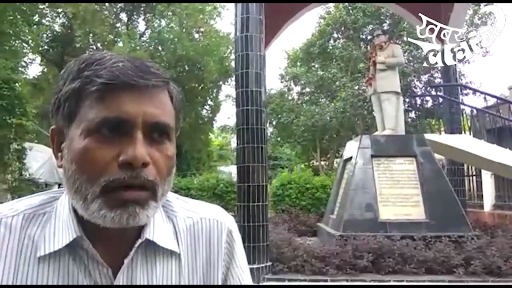
R.P. Chaudhuri, manager of the Sanghamitra Buddha Vihar in Banda said that most people around make much of Ambedkar statues but know little of his “andolan”. 2017.
This is not to say that there aren’t instances and figures in U.P. that go beyond the iconography and walk the talk. We think of lawyer and political aspirant, Meera Bharti, and her long association with Dalit organisations from BSP to Bhim Army, M.O.S.T Yuva Jagriti Sansthan and the newly formed Swatantra Janta Raj Party in 2019 on whose ticket she fought and lost the Lok Sabha elections. In 2016 our own EIC Kavita Devi’s father fought Panchayat elections for the first time.
So far over successive elections and close KL attention to the ‘Dalit vote’ in Bundelkhand, BJP has swept the elections, and Babasaheb’s radical anticaste principles, though enshrined in the Constitution and legislative fabric of the country, seem… far.
Still, there are images and moments that one cannot forget. U.P.’s own Chandrashekhar Azad emerging from a crowd in the Jama Masjid, holding the Constitution with a photograph of Ambedkar raised high above him, just hours after being released from prison is one.
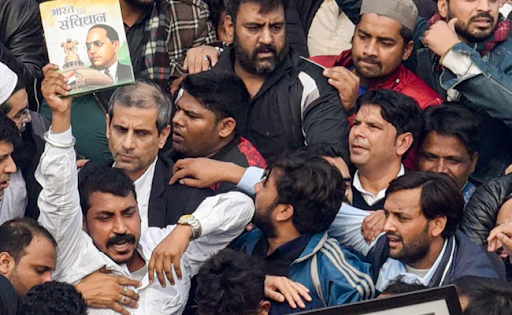
Bhim Army Chief Chandrashekhar Azad at an anti-NRC-CAA protest at the Jama Masjid. Photo: NDTV, December 21 2019.
These persist despite the frequent contestations over Ambedkar’s stone likeness. The fact remains that all you can behead is stone. The ideas and people resisting oppression and caste keep springing forth, just when you least expect it. Here we echo scholar Ravikant Kisana who writes, “The indomitable spirit of Babasaheb refuses to be frozen behind a frame, as the eternal rebel, even his image refuses to stop resisting… refuses to become a plaything or pliable symbol for Brahminical hegemons.”
On Ambedkar Jayanti just this past week, images and iconography of Ambedkar were everywhere in this post-Covid virtual world. Particularly on Instagram where reinterpretations and loving depictions of Ambedkar as a ‘Birthday boi”, and smiling over a birthday cake by Dalit and Bahujan artists, brought alive the celebration. This too is iconography and resistance and assertion. Claiming joy is significant.
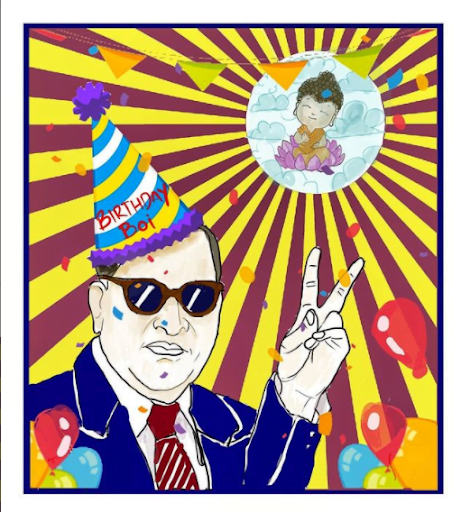
‘Birthday card for our emancipator’ by Ajinkya Dekhane.
As Dalit artist and writer, Rahee Punyashloka put it, “I am so, so utterly moved by the incredible outpouring of celebratory joy, articulation, and expression that was on display by our people for Ambedkar Jayanti yesterday. It was the first time ever that I felt like I truly belong on social media; the first time that I could glimpse the enormous potency, the inevitability of an Ambedkarite future springing from our hands.”

Art on the occasion of Babasaheb Ambedkar’s birthday by Shrujana Niranjani Shridhar.
Riddhi Dastidar is a writer and researcher in New Delhi. Their work focuses on disability justice, gender and culture. You can follow their work at riddhidastidar.com.