Yesha Tshering Paul details how gendered disinformation operates in rural India, where online and offline threats are one and the same.
The threat thrives in a hybrid ecosystem, spreading instantly from WhatsApp to local communities where honor and reputation are policed by social networks and village councils. Vulnerability is compounded by shared devices, low literacy, and intersectional attacks (targeting women based on caste and religion). Since local police often blame the victim, the high personal risk forces women into complete digital withdrawal. Paul argues for systemic responsibility, stating that solutions must be localized, community-led, and focused on building safe digital spaces where women can participate without being sexualized.
writing – Sejal
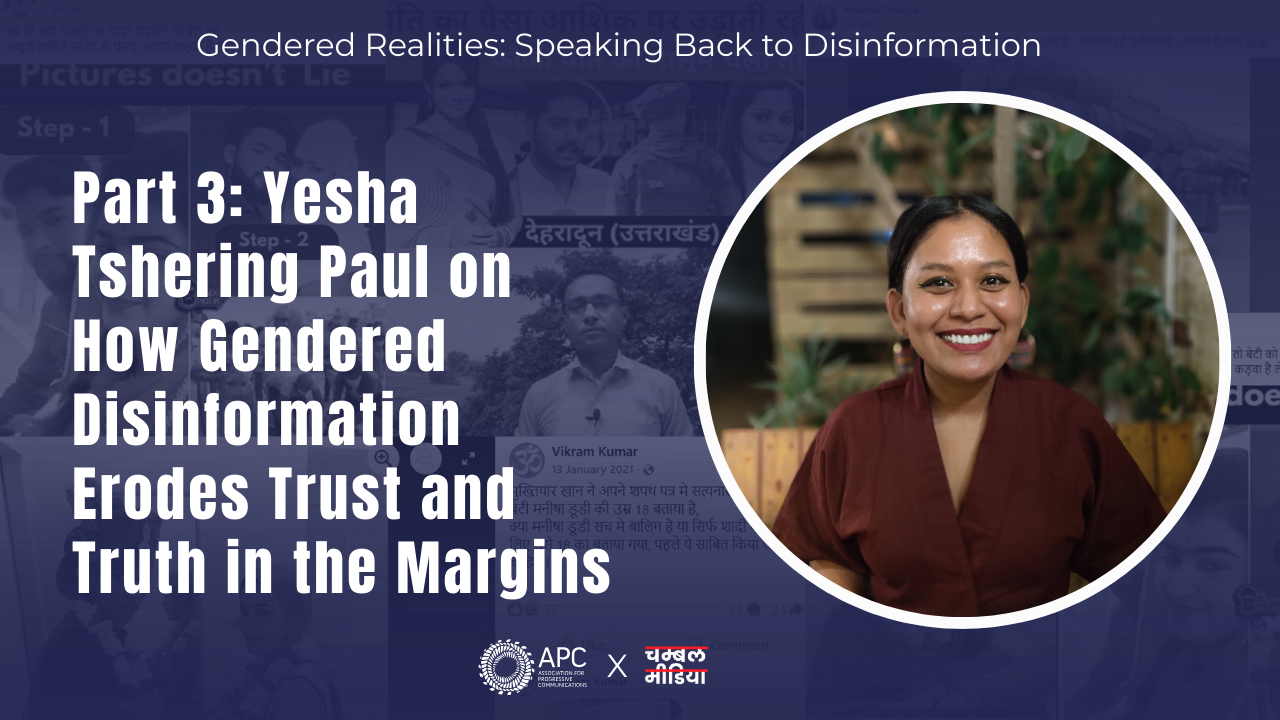
photo credit: Sejal
About the series:
Gendered Realities: Speaking Back to Disinformation is a three-part interview series bringing together journalists, researchers, and digital rights experts who have been documenting and challenging gendered disinformation. From tracing how hate is seeded and amplified online to examining its real-world consequences for women, particularly those from marginalised communities, the series explores the architecture of online harm and the urgent need for systemic change.
In the third and our final installment, researcher Yesha Tshering Paul draws from her fieldwork across rural India to unpack how gendered disinformation operates through tight-knit ecosystems where online and offline worlds are deeply entangled. In these contexts, disinformation travels through WhatsApp forwards, tea shop gossip, panchayat diktats, often targeting women’s autonomy, mobility and reputations.
Yesha is an independent researcher exploring the multifaceted nature of information disorder. She has previously worked in criminal law, parliamentary research, and policy research on the interplay of emerging technologies and civil liberties such as privacy, surveillance and digital identity in India. You can find her on Twitter and Linkedin.
KL: How would you define gender disinformation in the rural Indian context?
Yesha: Gender disinformation refers to false or harmful information that targets women and gender or sexual minorities. In rural and semi rural India, it plays out differently because of specific social, infrastructural and cultural factors.
Communities are closely knit. Caste and kinship networks are strong, so even when disinformation begins online, it spreads just as quickly offline through word of mouth and local gatherings.
Access to technology is also unequal. Many women do not have personal phones and rely on shared devices, which leaves them with little control over what they see or share. Low digital and general literacy heightens their vulnerability, particularly to false information about government schemes that promise benefits in exchange for personal data.
Finally, gender disinformation often takes an honour based form. A woman’s perceived misstep becomes a family or community issue, which amplifies the fallout.
KL: What are the main platforms or ecosystems through which gender disinformation circulates in rural areas?
Yesha: It is a hybrid ecosystem. Online, WhatsApp is dominant, followed by Facebook and lighter versions of both platforms that function better with poor connectivity. Some people use Instagram, but regional language platforms like ShareChat or local messaging apps often play a bigger role. These platforms receive little scrutiny or research.
Offline networks are equally influential. Information travels quickly through tea shops, temples, markets and other everyday spaces. Local newspapers, regional TV channels and newsletters also contribute to the spread of disinformation.
KL: What are the main platforms or ecosystems through which gender disinformation circulates in rural areas?
Yesha: It’s really a hybrid ecosystem. Online, WhatsApp is the most dominant platform, followed by Facebook, especially lighter versions like WhatsApp Lite and Facebook Lite that work better in areas with poor connectivity. Some people may use Instagram, but more importantly, there are localized apps like ShareChat and other regional-language messaging platforms that often escape mainstream scrutiny. These tend to fly under the radar, with little research or oversight.
Offline networks are equally influential. In tight-knit rural communities, information, whether true or false, spreads quickly through everyday spaces like tea shops, temples, or markets. Local newspapers, regional TV channels, and newsletters also play a big role in the spread of disinformation.
KL: Could you speak about the forms of moral policing and rumor mongering that connect with gender disinformation?
Yesha: Much of it stems from the idea that women carry family and community honour. Their movements, friendships and phone ownership become public matters. Girls and women are constantly monitored and their freedoms restricted.
Panchayats reinforce this through regressive rules, including bans on mobile phones for girls. As women become more educated and assertive, community backlash grows. Fears around elopement or interfaith relationships often lead to harsh punishments. When a rumour or manipulated photo circulates, the woman is usually blamed regardless of the truth.
KL: What impact does gendered disinformation have on women’s digital participation and expression, especially with regard to self censorship?
Yesha: Digital participation is already low for women in rural and semi-rural areas, and self-censorship is high. When gender disinformation targets them, it becomes worse. Unlike in urban areas where someone might be able to adjust privacy settings, report abuse, or take a short break from social media, those options don’t really exist in smaller communities. If something goes viral about you there, everyone knows who you are. Simply shutting down your online profile doesn’t help, because the impact follows you offline. You might still face judgment when you step outside your home.
In these settings, the only option often is to disappear from the internet completely. Women can’t just reduce their visibility or modify what they post. Many resort to creating fake profiles or using secret phones to stay online. But even that comes with risks, because if discovered, it could lead to further shaming.
There’s also the issue of having no real support systems. Cyber cells, where they exist, are mostly limited to cities. In rural areas, if a woman tries to report such harm at a police station, she’s more likely to be blamed, asked why she took those pictures or why she shared them in the first place. So rather than finding justice, she faces more stigma. That fear pushes many women into full self-censorship, because the cost of being online is simply too high.
KL: How do limited digital literacy, device access and language barriers worsen the problem?
Yesha: Device access is a huge issue. If a woman shares her phone with her husband, brother, son, or others, she has no privacy. Many gender disinformation cases involve photos that were never shared with anyone. These might just be pictures stored on her phone- something as simple as her sitting or relaxing somewhere which someone else can access and misuse. Without personal control over her device, she cannot protect herself from this kind of exploitation.
Digital literacy makes a big difference too. Without it, women are more vulnerable to both being targeted and unintentionally spreading disinformation. Someone with basic awareness might pause and think about whether something is fake or what action they can take. But many rural women don’t even know they have options. If something happens, they might not realize they could file a complaint on Facebook or WhatsApp, even if that may not lead to much. There is a general sense that no help is available, either online or offline.
Language barriers make things even harder. Navigation has improved slightly, since platforms are now available in more regional languages, especially for basic use or financial services. But when it comes to help sections, complaint systems, or reporting abuse, the options are still very limited. There is also the issue of understanding context. If a woman reports that someone used a word in her local dialect that is abusive, the moderator may not understand the seriousness of it. Even if the moderator is Indian, they might not recognize the term as offensive. In a country with so many dialects, this gap in understanding often results in complaints being dismissed or ignored.
KL: How do caste, religion and class compound women’s vulnerability to gendered disinformation?
Yesha: When we talk about caste in the context of rural areas, it’s important to remember that even when I said these communities are relatively homogeneous, that’s usually within caste boundaries. So if I am from a lower caste, I might live on the margins of the village or even outside it. The way I am treated, both online and offline, is completely different.
For lower-caste women in particular, the stigma is not just about caste. There is also a hyper-sexualization that happens. They’re often seen as easy targets for abuse, and this translates online too. The attacks are not only about their caste identity but also include sexual slurs and insinuations. It’s not necessarily calling someone a sex worker outright, but implying things like that through language or memes.
Even skin tone becomes part of the disinformation. We see how this plays out with prominent Dalit women leaders like Mayawati or even President Droupadi Murmu despite their status, they are still targeted with casteist and colorist attacks. If this happens to them, it’s much worse for women in small communities where the risks are more immediate.
In tight-knit rural areas, everyone knows each other. If you are targeted online, the same people around you are consuming that content. So it’s not just about facing online abuse from strangers; it’s your neighbors, relatives, or community members. That makes the danger more intense. Unlike someone sitting in Delhi who might face online trolling but can distance herself, women in villages often cannot escape. They live among the same people spreading or reacting to that disinformation.
When it comes to religion, Muslim women face a whole other layer of vulnerability. Across the board, gender disinformation often starts with attacking a woman’s sexuality and honor. With Muslim women, this gets deeply communal. There are all kinds of messages and memes—some of which even use Ram Mandir analogies, like “conquering” Muslim women in ways that are extremely violent in implication. There’s also a widespread belief that Muslim women are oppressed and in need of saving, which becomes an excuse to judge or control them.
This “rescue narrative” is paired with the misuse of tropes like triple talaq to paint an image of backwardness. At the same time, Muslim women are sexualized through threats and content like what we saw during the Sulli Deals: where fake auctions were created targeting Muslim women journalists and activists. Muslim men, on the other hand, are demonized as aggressors, especially in the context of Hindu-Muslim relationships. This is similar to how Black men are framed in the West: hypersexual, predatory, and threatening.
There’s also this idea that Muslim men are seducing Hindu women to convert them to what is now widely referred to as the “love jihad” narrative. We see this playing out even in cities, where vigilante groups click pictures of interfaith couples sitting at cafes and post them on Facebook. In rural communities, where surveillance is tighter and suspicion of outsiders is more deeply entrenched, this gets even worse. A relationship across religious lines can spark immediate moral panic.
And then there’s how quickly these things spread. Imagine a photo of a Hindu girl with a Muslim boyfriend circulating on social media. Sometimes, people will comment with a fridge emoji. For those who know the context, it’s a deeply violent reference to incidents like the Shraddha Walker case. But how do you explain something like that to a content moderator, especially if the context is so specific and cultural?
So, the religious angle isn’t just present, it’s amplified in small, close communities. Fears around elopement, interfaith marriage, and community honor are triggered easily, and the consequences are serious. They aren’t just reputational; they can also become physical threats.
Class plays out differently. Wealth does not always translate to more freedom for rural women. In fact, women from financially better off households may be more tightly controlled and denied phone access. Women from lower income backgrounds may have more mobility because of work, but lower literacy makes them more susceptible to scams and disinformation, especially those designed to mimic government schemes and presented by women who resemble the target audience.
Across caste, religion and class, the threats overlap, but the consequences are most severe in communities where surveillance and rumor circulation are personal and immediate.
KL: Who should be responsible for countering gendered disinformation: platforms, the state, community actors, or users?
Yesha: Platforms carry the greatest responsibility, followed by the state. But platforms are where gendered disinformation flourishes. The architecture of social media platforms is fundamentally designed to amplify misinformation and disinformation because the algorithms are driven by what gets the most clicks, which tends to be the most controversial content. Even if a post is fact-checked, if it doesn’t generate engagement, it gets buried. That’s where platforms should step in and amplify fact-checks or boost visibility for fact-checking organizations, but they often don’t.
I don’t think platforms take fact-checking seriously enough. They may have partnerships with fact-checking groups, but the content still doesn’t reach users at scale. And even when fact-checking does happen, it has limitations. For example, if the misinformation is based on religion or mythology, something emotionally significant, people are less likely to accept that it’s false. If someone believes that something related to the Ram Mandir is a historical fact, and a fact-checker says otherwise, it often just entrenches their belief.
Also, platforms like Meta have actually pulled back on fact-checking and introduced community notes instead. But that leaves the burden on users to interpret whether something is true. Twitter, for instance, started suppressing posts that included links to external news sources, making it harder to provide verified context. This discourages people from linking to credible sources and, again, undermines fact-checking.
When it comes to content moderation, most of it is done by algorithms, with very little human oversight. This means posts that rely on regional context or dialects often go unnoticed. There are huge gaps; things just slip through. Platforms aren’t prioritizing investment in moderation that is sensitive to cultural and local nuances.
Now, the state does share responsibility too. Our laws are attempting to catch up with the pace of technological development, but they’re still far behind. One concerning trend is governments appointing their own fact-checking bodies. For instance, in Karnataka, the government appointed an official fact-checker, which raises the question of how we trust the “truth” when it’s coming from a politically aligned source. That approach is extremely problematic.
But even beyond national-level laws, the local implementation is a bigger issue. Where do I go when something happens to me? Even in urban areas, police training on cybercrime is limited. Manuals might include cyber elements now, but the sensitivity and education around these issues are usually restricted to higher-ranking officers. When you walk into a regular thana with a complaint, especially as a woman, you’re unlikely to get proper support.
This is even worse in rural areas, where awareness and sensitivity are practically non-existent. That’s a huge gap. If I have to report that I shared intimate photos with my boyfriend and they were misused, it’s already incredibly difficult. But then to be shamed by a police officer or to have the whole village know within minutes, that’s the kind of risk women are dealing with. There’s no privacy. That local support system is one of the biggest points of weakness.
So yes, platforms and the state are responsible, but solutions need to come from the ground up too. Digital literacy programs are essential, but we also need more localized fact-checking bodies and better trained rural cyber cells. Community-led efforts matter. For example, during COVID, ASHA workers used WhatsApp to counter vaccine misinformation. That model can be adapted to tackle gendered disinformation too.
People in small communities don’t trust outsiders or abstract institutions. If a random organization posts a fact-check on a website, even in Hindi, it won’t be trusted. It has to come from someone within the community, someone familiar and credible. That’s why leveraging WhatsApp through local figures like ASHA workers, teachers, or other trusted individuals is important. They can counter misinformation and raise awareness in a way that resonates.
There are also helplines and resources available in regional languages, but people don’t know about them. Awareness about these options is very low. That’s another area where work is needed, letting people know what non-state remedies and helplines exist and making sure they can access them safely and privately.
KL: What would a safer, more equitable digital space look like for rural women?
Yesha: I think a safer space for women starts with the ability to build communities. Women already create safe spaces offline small, trusted circles where they can talk freely. It would be great if something similar existed online. Safe communities where women can express themselves, ask questions, and get answers without fear.
We do have things like WhatsApp groups or Facebook groups, but we need more privacy and a greater sense of safety. Not necessarily anonymity, but just knowing that you won’t face backlash for being visible or for speaking up. And this applies not just to women but also to gender and sexual minorities. Everyone should have access to spaces where they can talk to others from their community without constantly worrying about what people will say or what the repercussions might be.
Spaces like that would also help counter misinformation and disinformation. If you can ask someone a question and have a conversation, you’re less likely to believe something blindly.
Beyond that, a more equitable internet would be one where I can participate in public forums, be politically active, or just speak my mind without having to constantly fear sexualized attacks. If someone wants to criticize my opinion, that’s fine. But I don’t want my nudes to be leaked, or morphed images of me to go viral, or my phone number to be shared online with messages saying I’m looking for sex. Those are the kinds of things that make the internet unsafe.
Even the attacks shouldn’t be gendered. I’m okay with disagreement or criticism. But I don’t want my body, my dignity, or my safety to be what’s attacked. A more equitable internet would be one where I’m not sexualized just because I chose to be visible.
Criticism, anyone can handle. If someone doesn’t agree with me, that’s okay. But don’t attack me as a woman.
And it’s not just the individual woman who suffers. I remember one case where a woman’s boyfriend took nude photos from her phone and didn’t just leak them- he also added her father’s name and their home address. So now her whole family was being targeted. There are always secondary victims in these cases. You see it even with celebrities. When trolls attacked Virat Kohli, they went after his daughter. That’s the level of cruelty we’re dealing with.
This is the final part of our interview series on Gendered Disinformation, where we speak with leading researchers, activists, and thinkers on what it means to be targeted, how resistance is built, and what needs to change across tech, media, policy, and society. Produced by Chambal Media in collaboration with the Association for Progressive Communications (APC).
यदि आप हमको सपोर्ट करना चाहते है तो हमारी ग्रामीण नारीवादी स्वतंत्र पत्रकारिता का समर्थन करें और हमारे प्रोडक्ट KL हटके का सब्सक्रिप्शन लें’